
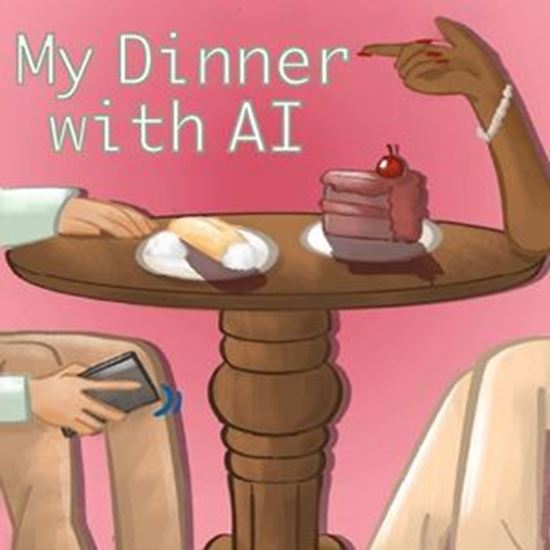
My Dinner with A I
Chad's got a problem. Every time he goes on a date with a girl, he gets so nervous he has no idea what to say. So, his friend Steve gives him some advice: pop in an earbud and let Dia-Logic, a great new AI app, tell him everything to say. Of course, not everything goes as planned... Awkward moments and raucous laughter abound in this one act comedy that examines what it means to really connect with someone in the 21st century.
Productions
Behind The Scenes
With Playwright Graham W. Osborne
What inspired you to write this play?
With all the AI programs and debates going on surrounding them, I started to wonder about the value of our own thoughts and ideas versus those of a computer program. What if we just allow ourselves to become the “interface” for an artificial intelligence program rather than trying to express our own personalities? Also, how hilarious might it be if someone tried to let a computer talk for him, and it went very badly? I wanted to explore those questions in a comedic way that still had some real humanity at its heart.
What's your favorite part or line in the play? Why?
I’m quite fond of the moment when the “Ad Voice” makes Chad talk about gas pains during his date. How often have any of us been frustrated or inconvenienced by an ad in a free version of an app we’re using? I love how that moment takes things a step further, making the ad both inconvenient and embarrassing.
I’m also partial to the line about the “Roomba.”
Where did the characters come from? Are they based on people you know?
Chad certainly comes from an exaggeration of my own anxieties I had in my twenties about dating. But Rose’s tendency to blurt out embarrassing things is probably based more on myself, as I have a habit of talking too much and not always considering the consequences of what I say. Steve isn’t based on anyone in particular, except maybe the type of guy I wish I was more like when I was younger: more confident, more self-assured. Dia-logic isn’t based on me, though. That’s just my best approximation of the kinds of responses I had seen some of the major AI programs give: almost human, but a little too perfect and dull to be real.
What did you try to achieve with this play?
It was my hope that this play would be both a humorous and thoughtful exploration of how technology is changing human interaction and what we should do about it. While I have my own opinions about AI and human connection, I wanted to keep things light and never get preachy. At the same time, I didn’t want a funny but ultimately meaningless story. I tried to make sure the audience walked away both entertained and thinking.
Do you have anything else you'd like to add?
Despite its subject matter and characters, no part of this show was written, edited, or revised by any type of artificial intelligence. I chose to use actual intelligence, instead.