
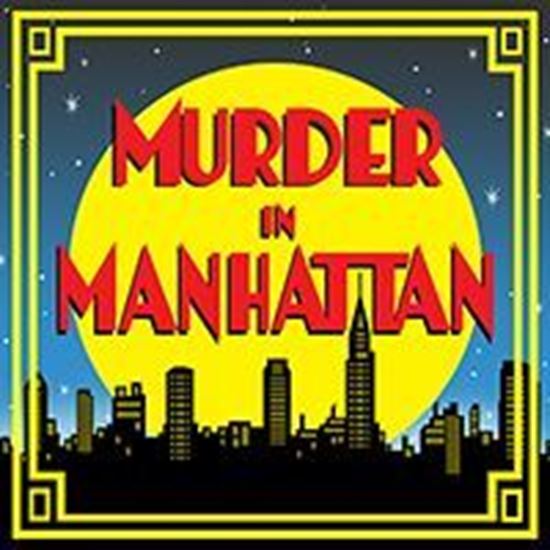
Murder in Manhattan
This murder mystery play set in the 1920s opens on a party in full swing at novelist Scarlett Stringfellow’s chic Manhattan apartment. All of Scarlett’s friends and loved ones--and even a few strangers--are there to celebrate her forthcoming third novel and her impending marriage to Jasper Banks, the son of one of Wall Street’s most notorious businessmen. Like all good murder mysteries, the lights cut out, a gun goes off, and the worst person in the room ends up dead. Enter Detective Charlie Dolan, who has to find the murderer amongst a group who can’t stop arguing, who don’t like snitches, and ... who all wanted the victim dead!
Productions
Behind The Scenes
With Playwright Julia Romano
What inspired you to write this play?
After the success of “The Odyssey: A Comedy, Mostly,” also available through Eldridge Plays and Musicals, I decided to write an original play for the high school Drama Club I direct. I thought a mystery might be a fun change after our Drama Club had performed back-to-back comedies, and I landed on the 1920s setting in New York after brainstorming topics and time periods that interested my students the most.
I then revisited some of my old writing for inspiration. I stumbled upon a play I wrote in middle school; I hadn’t thought about the play for years, and while a lot of it was very cringey, it had the perfect twist for this new play. I got rid of the cringe (and made parts of it genuinely funny while keeping the suspense and drama of a murder mystery), created some dynamic characters and interesting interpersonal relationships, and kept the twist. Et voila--”Murder in Manhattan” was born.
What's your favorite part or line in the play? Why?
Alice’s monologue is very special to me. Her story is an amalgamation of experiences of people who lived in New York during the Industrial Revolution, including my own family. I am a high school history teacher, and the Industrial Revolution unit is one of the most memorable units for my students, specifically because of the individual stories I incorporate into my lessons. I wrote Alice’s part with my family, and the thousands of unnamed New York families who survived living in tenements, in mind.
I also love Charlie’s line: “People always tell you the truth--all you have to do is listen hard enough.” It is one of the most important lessons that I have learned as a teacher... and as a human.
Where did the characters come from? Are they based on people you know?
The characters are a mix of people who I hoped my students could connect to and look up to (Minnie and Jasper, for example) and characters that I crafted for actors after auditions were done. In fact, I ended up revising most of the play after auditions simply because of all the amazing student actors we had. Frank Edwards is one of those characters. During auditions, one of my talented freshmen came in with a creative energy that needed to be channeled in a character that didn’t exist. Therefore, I crafted an original character just for him, and he stole the show!
What did you try to achieve with this play?
My goal was to craft a mystery that the audience found engaging but not obvious. When my Drama Club performed “Murder in Manhattan” in March 2025, only a handful of people in our audience figured out who the killer was before it was revealed--everyone else was surprised but delighted by the twist. I was proud that the mystery at the heart “Murder in Manhattan” was easy to follow but not easy to solve.
Do you have anything else you'd like to add?
First, I wrote “Murder in Manhattan” from the perspective of a Drama Club Director. I wanted there to be flexibility, opportunities for different student actors, and a lot of space for joy and creativity.
There is a variety of characters for seasoned actors, growing performers, and new castmates alike. There are 21 speaking characters and 2 defined non-speaking characters (who can be teacher cameos), but there is room for a few more actors either as background characters in the party or as coroners. Some of the parts are also flexible gender-wise: the musicians have dual character names depending on who lands the role and our Benny the Bartender was played by a girl. Additionally, even though Detective Charlie Dolan and Scarlett Stringfellow are clearly the main characters, each character does get a moment to shine, and there are even a few scene stealing opportunities: Jasmine, Frank, Benny the Bartender, Ernest, and even Louise all have the opportunity to be the most memorable character in the show.
Most importantly: this play is set in one location for the entirety of the show, making it budget-friendly (which was important to us) or an opportunity to go over the top with sets and 1920s costumes.
Second, Claflin Hall Room 324 is a real place at Wellesley College, my alma mater. Some of the loveliest people I have ever known lived there while I was their RA. Scarlett, Minnie, and Gertrude totally have the Wellesley ethos, and I know they would have had a lot of fun living in Claflin and studying at Wellesley.